A business can have a beautiful brand identity and still struggle to explain why customers should choose it.
It can also have a strong strategy that never makes a lasting impression because the brand looks and sounds inconsistent.
That is why brand identity and brand strategy should not be treated as the same thing.
They solve different problems.
A simple way to think about it is:
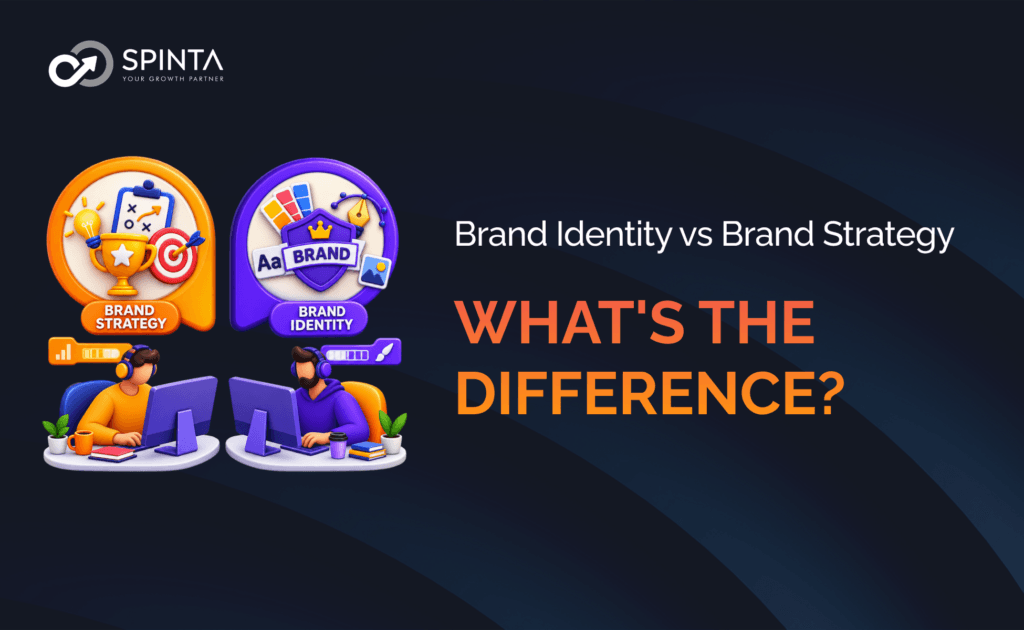
Brand strategy determines what the brand needs to stand for and where it should compete. Brand identity determines how that strategy becomes visible and recognisable.
One provides direction.
The other provides expression.
The strongest brands connect the two.
What is brand strategy?
Brand strategy is the thinking behind the brand.
It establishes the direction the business wants its brand to take and how it should be perceived by the people it wants to reach.
Depending on the business, a brand strategy can address questions such as:
- Who are we trying to reach?
- What problem do we solve?
- What do we want to be known for?
- How are we different?
- Why should customers believe us?
- What position should we occupy?
- What should the brand feel like?
- What should customers remember?
These questions come before many visual design decisions.
Without strategic clarity, design choices can become disconnected from the business.
A colour might look attractive.
A logo might look modern.
A website might look premium.
But none of those decisions automatically create meaningful positioning.
What is brand identity?
Brand identity is how the brand expresses itself.
It turns the strategic direction into recognisable visual and verbal elements.
This can include:
- Logo
- Colours
- Typography
- Photography
- Graphic elements
- Visual style
- Brand language
- Tone of voice
- Messaging
- Brand applications
Spinta describes branding as crafting concepts into compelling narratives and creating brand identities that embody a brand’s story, values and aspirations. Its listed branding capabilities include Logo Design, Brand Identity Design, and Rebranding and Brand Refresh.
The identity is therefore what customers can experience and recognise.
It gives the strategy a form.
Brand strategy vs brand identity
Here’s the simplest distinction:
Brand Strategy | Brand Identity |
Defines direction | Expresses the direction |
Focuses on positioning | Focuses on recognition |
Answers “What should we stand for?” | Answers “How should we look and sound?” |
Defines audience and differentiation | Defines visual and verbal expression |
Guides decisions | Creates recognisable assets and systems |
Is primarily strategic | Is primarily expressive |
The two are connected, but they should not be confused.
A brand identity without strategy can become decoration.
A strategy without identity can remain invisible.
Why the distinction matters
Imagine a company says:
“We want to be perceived as a premium, trusted specialist.”
But its visual identity looks generic.
Its messaging focuses on discounts.
Its photography feels inconsistent.
Its website communicates price rather than expertise.
There is a gap between strategy and identity.
Now imagine the opposite.
The company has a beautifully designed identity with sophisticated typography, strong photography and a distinctive colour system.
But internally, nobody can clearly explain:
- Who the company is for
- What makes it different
- What it should be known for
- Why customers should choose it
The identity may be attractive, but it lacks strategic direction.
This is why the relationship between the two matters more than either one in isolation.
What comes first: strategy or identity?
In most brand-development situations, strategy should provide the foundation for identity.
The sequence is broadly:
Business direction → Brand strategy → Brand identity → Brand expression → Customer experience
That does not mean the process is always perfectly linear.
Design can reveal strategic questions.
Creative exploration can challenge assumptions.
Customer feedback can change positioning.
But strategic clarity should ultimately guide the identity.
Otherwise, the design risks becoming disconnected from the reason the brand exists.
A practical example
Consider a fictional technology company.
Its strategy is:
Positioning: A technology partner that makes complex digital transformation easier for growing businesses.
Audience: Business leaders who need technology expertise but do not want unnecessary complexity.
Differentiation: Making sophisticated technology easier to understand and implement.
Now consider the identity.
The visual system might emphasise:
- Clarity
- Simplicity
- Strong hierarchy
- Accessible language
- Confident but approachable imagery
The identity is now reinforcing the strategy.
The customer does not need to read the strategy document.
They experience its implications through the brand.
What happens when strategy and identity don’t match?
Several problems can emerge.
The brand attracts the wrong customers
If your identity communicates one positioning while your business actually wants another audience, you can create a mismatch before a sales conversation even begins.
The business becomes difficult to differentiate
A generic identity makes it harder for strategic differentiation to become visible.
Marketing becomes inconsistent
Different teams interpret the brand differently.
Campaigns begin to look disconnected.
Design decisions become subjective
Without strategic principles, discussions can become:
“Do you like this colour?”
“Does this logo look modern?”
“Which option feels better?”
Strategy changes the conversation to:
“Which option better communicates what we want to be known for?”
That is a much stronger basis for decision-making.
Brand identity is more than a logo
This distinction is particularly important.
A logo is one component of brand identity.
It can create recognition, but it cannot carry the entire brand strategy.
A complete identity can include:
Visual system
- Logo
- Colour
- Typography
- Imagery
- Graphics
- Layout
Verbal system
- Messaging
- Tone
- Vocabulary
- Headlines
- Calls to action
Application system
- Website
- Social media
- Advertising
- Presentations
- Other customer-facing materials
The identity becomes powerful when these elements operate as one system.
Brand strategy is more than a mission statement
The opposite misconception is equally common.
Brand strategy is not simply writing a purpose statement and choosing a few brand values.
A useful strategy needs to inform decisions.
It should help answer:
- Which audiences matter most?
- What position should we own?
- What makes us different?
- What should customers associate with us?
- What should we communicate consistently?
- How should we behave across customer interactions?
The strategy becomes useful when it changes what the business actually does.
How to know which problem you have
If your team says:
“Our brand doesn’t look right anymore.”
You may have an identity problem.
If your team says:
“We’re not sure what our brand should stand for anymore.”
You may have a strategy problem.
If both are true, you probably need to address both.
Another useful diagnostic is to ask:
“If we changed our logo tomorrow, would the underlying business positioning still be unclear?”
If the answer is yes, redesigning the logo is probably not the first step.
When should you focus on brand strategy?
Brand strategy deserves attention when:
- The business is entering a new market
- The target audience has changed
- The product or service offering has expanded
- The company is repositioning
- Differentiation is unclear
- The business has outgrown its original proposition
- Different teams describe the brand differently
These situations suggest that the business needs strategic clarity before or alongside identity work.
When should you focus on brand identity?
Identity work becomes especially relevant when:
- The visual identity feels outdated
- Brand assets are inconsistent
- The logo no longer fits the business
- Marketing materials lack cohesion
- The brand is difficult to recognise
- The current identity does not reflect the intended positioning
Here, the strategy may still be sound.
The challenge is expressing it effectively.
When do you need both?
Many growing businesses need both.
The strategy may have evolved.
The identity may have remained unchanged.
That creates a gap between:
Who the business is becoming
and
How the market currently sees it.
A coordinated branding process can address that gap by aligning the strategic foundation with the identity system.
A simple framework for aligning the two
Use this five-step process.
Step 1: Define the business direction
Where is the business going?
Step 2: Define the desired perception
What should customers think and feel about the brand?
Step 3: Establish differentiation
What makes the brand meaningfully different?
Step 4: Translate strategy into identity
Determine the visual and verbal elements that can express the desired positioning.
Step 5: Apply the system consistently
Make sure the identity works across the customer touchpoints that matter.
This creates a connection between strategy and execution.
The relationship in one sentence
If you remember only one thing, remember this:
Brand strategy decides what the brand should mean. Brand identity helps people recognise and experience that meaning.
You need the first to create direction.
You need the second to create expression.
And you need both to build a coherent brand.
Final takeaway
The debate around brand identity vs brand strategy should not be about choosing one over the other.
They have different jobs.
Brand strategy establishes the foundation: audience, positioning, differentiation, personality and direction.
Brand identity turns that foundation into something people can see, hear, recognise and experience.
When they work together, design stops being decoration.
It becomes a strategic expression of the business.
Strategy gives the brand direction. Identity gives that direction a recognisable form.
Spinta’s branding approach connects concepts, narratives, strategy and identity to create brand expressions that reflect a business’s story, values and aspirations. Its official capabilities include Logo Design, Brand Identity Design, and Rebranding and Brand Refresh.
For businesses unsure whether they need strategic brand work, identity design, or both, the starting point should be identifying whether the underlying problem is one of direction, expression, or alignment between the two.
The five strategic questions identity should answer
A useful brand identity should make the underlying strategy easier to experience.
1. Who is the brand for?
The identity should feel appropriate for the intended audience.
A brand targeting enterprise decision-makers may need a different expression from one targeting teenagers.
This does not mean every industry needs to look conventional.
It means the identity should deliberately communicate to the audience rather than simply reflect the designer's preferences.
2. What does the brand stand for?
The identity should reinforce the brand's personality and values.
If a company wants to communicate simplicity, its visual and verbal systems should not create unnecessary complexity.
If it wants to communicate innovation, its identity should have a distinctive and forward-looking expression.
The point is alignment.
3. What makes the brand different?
Differentiation should not exist only in a strategy document.
Customers should be able to experience some expression of it.
If every competitor uses similar visual language and messaging, even a well-written positioning statement may struggle to create recognition.
Identity can help turn differentiation into something customers can actually see and remember.
4. What should people remember?
Brands operate in environments full of competing messages.
A strong identity creates recognisable cues.
That might come from:
- Colour
- Typography
- Visual composition
- Photography
- Language
- Brand symbols
- Distinctive messaging
Not every element needs to be unusual.
But the overall combination should create recognition.
5. How should the brand behave?
Brand strategy is not only about positioning.
It also establishes a sense of personality.
Is the brand:
- Confident?
- Approachable?
- Precise?
- Energetic?
- Sophisticated?
- Playful?
- Authoritative?
Those qualities need to translate into communication.
Otherwise, the intended personality remains abstract.